io.github.lanbass869-cell/memtether
Cross-client AI memory hub: agents share one SQLite memory.db via file-level pointers.
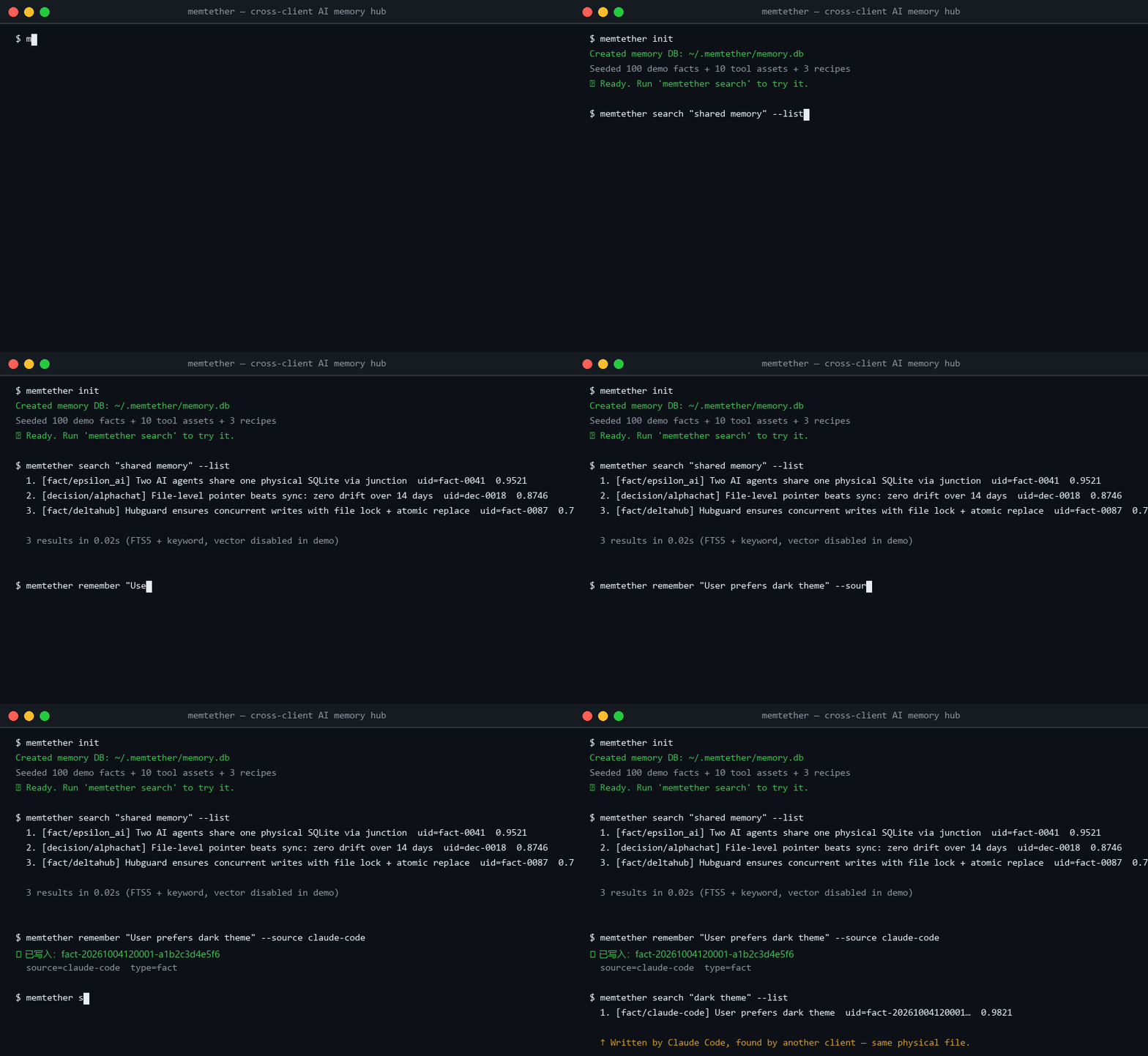
MemTether — The AI Memory Court
Your agent remembers things. Who audits what it remembers?
MemTether is a local-first memory hub for multi-client AI agents. While most memory systems compete on retrieval accuracy, MemTether competes on governance: who wrote each fact, when it took effect, what it superseded, which conflicts a human adjudicated, and a tamper-evident hash chain anyone can verify — no code, no dependencies. Retrieval is provided (SGM deterministic SQL routing + hybrid embedding), but it is not the headline: agent memory that you can audit, correct, and trust is.
Coming from mem0, Zep, or Letta? examples/mem0_migration.py
shows a complete round-trip migration from a mem0 JSON export — no mem0
SDK required.
$ memtether court fact-20261007-abc
+============================================================+
| MEMTETHER MEMORY COURT - CASE FILE                          |
| 1. CONTENT    Clash proxy port is 7897                      |
| 2. TEMPORAL   valid: 10-05 → present | known: 10-05 → now   |
| 3. PROVENANCE #1 remember by=codex → #2 correct by=user     |
| 4. CONFLICTS  case #3: vs fact-...old verdict=superseded    |
| 5. INTEGRITY  chain: PASS (3 anchors, 42 entries hashed)    |
+============================================================+
TL;DR
- Your AI clients forget each other? Every agent keeps its own memory. MemTether gives them one shared, governed brain via file-level pointers — no cloud, no sync.
- Your AI writes things it should not? Every memory carries a source identity and a hash-chained audit trail. Tamper with the database and the chain detects it — run
python examples/audit_chain_demo.pyto see it turn red. - Your AI changed its mind? Corrections never delete. Bi-temporal supersession keeps who-changed-what-when-why forever, queryable at any past point in time.
Run it yourself:
$ python examples/audit_chain_demo.py
写入 25 条记忆(自动生成 2 个审计锚点)...
篡改前 verify_chain: PASS {'anchors': 2, 'entries_covered': 20}
模拟攻击者直接改库...
篡改后 verify_chain: FAIL {'reason': 'chain hash mismatch'}
✅ 哈希链成功检测到篡改!

> Note: ntries_covered: 20 with 25 writes is expected — the hash chain anchors every 10 audit entries, so the last 5 writes sit in the unanchored tail until the next batch. Tampering with an *anchored* entry is what turns verification red.
Migrating from mem0
Already using mem0? examples/mem0_migration.py
shows a complete round-trip: mem0 JSON export → MemTether Exchange v1 →
live retrieval → back to mem0 format. No mem0 SDK required, bi-temporal
fields honestly marked temporal_source="backfilled".
Performance (microbenchmark, n=200, local SQLite)
| Operation | p50 | p95 | p99 |
|---|---|---|---|
| remember (insert) | 28.7ms | 34.6ms | 117.8ms |
| search (SGM entity) | 33.1ms | 39.5ms | 41.6ms |
| search (keyword) | 32.2ms | 35.0ms | 135.0ms |
| correct (supersede) | 50.8ms | 54.7ms | 54.7ms |
Reproduce: python _dev/benchmarks/bench_latency.py --n 200
Documentation
Under the hood: supersession chains (corrections never delete), bi-temporal timestamps (when facts were true vs when the system learned them), human-adjudicated conflict resolution, and a hash-chained audit log designed with EU AI Act Article 12 record-keeping requirements in mind (not certified compliance) record-keeping requirements.
One physical SQLite database, shared by every AI client via file-level pointers. No cloud. No API fees. No sync daemon. Greppable, git-able, yours — and auditable.
Compared to mem0 (66.6K★), Zep/Graphiti (31.5K★), and agentmemory (29.2K★): those systems either overwrite or delete old values. MemTether's supersession chain preserves the full history with source attribution and Q-Value ranking. EAF retrieval: 75.7% strict on LongMemEval 500Q (paired delta +19.4pp, McNemar p=7.8e-7).
How MemTether compares
| MemTether | memora (731★) | memtrace (486★) | icarus (290★) | mem0 (66K★) | |
|---|---|---|---|---|---|
| Supersession chains (corrections don't delete) | ✅ enforced | ❌ | ❌ | ✅ | ❌ overwrite |
| Evidence chain (tamper-evident, browser-verifiable) | ✅ court CLI + zip | ❌ | ❌ | ❌ | ❌ |
| Human conflict adjudication (decisions on record) | ✅ conflicts CLI | ❌ | ❌ | ❌ | ❌ |
| Bi-temporal (valid_from ≠ recorded_at) | ✅ 100% coverage on fact rows | ❌ | ✅ on knowledge-graph edges (not per-fact rows) | ❌ | ❌ |
| Source attribution (who wrote it, enforced) | ✅ registry + reject | ❌ | ❌ | ✅ provenance | ❌ |
| Bi-temporal (per-fact rows) | ✅ | ❌ | ❌ | ❌ | ✅ graph edges only |
| Conflict detection (rule-based + human review) | ✅ candidate generator | ❌ | ❌ | ❌ | ❌ |
| MCP server | ✅ | ✅ | ✅ | ❌ | ✅ |
| 23+ client adapters | ✅ auto-detect | ❌ | ❌ | ❌ | ❌ |
| Evaluation integrity framework | ✅ 5 patterns | ❌ | ❌ | ❌ | ❌ |
| CI: 9 jobs / 538 tests | ✅ | ? | ? | ? | ✅ |
| Language | Python | ? | Rust | ? | Python |
'Each cell reflects the feature's presence in the project's public documentation as of 2026-10-07. MemTether's differentiator is not any single feature — it's the combination of all governance dimensions in one local-first deployment.'
Artifact bundle with per-question records.



mcp-name: io.github.lanbass869-cell/memtether

Project page · Install · Docs · Reproduce · 中文文档
- Reproduce MemTether - Every claim has a command
- Founding 10 Challenge - 10 spots, 14 days, honest outcomes
- Live site (when GitHub Pages is enabled)
Quick Start
pip install memtether -i https://pypi.org/simple/
memtether init    # creates DB + connects all detected AI clients
That's it. MemTether detects Claude Code, Cursor, Windsurf, Codex, Gemini CLI and 18 more clients on your machine, writes MCP config, and verifies.
China users: if
pip install memtetherfails withNo matching distribution, the Tsinghua mirror may lag behind PyPI. Use:pip install memtether -i https://pypi.org/simple/
More install options
# One client at a time
memtether setup claude-code
memtether setup cursor
memtether setup gemini-cli    # run `memtether setup list` for all 23

# With semantic search (local embedding, no cloud):
pip install "memtether[vector]"          # 1. deps (chromadb, onnxruntime)
memtether download-models                # 2. weights (bge-m3-int8 ~560MB, or --profile bge-small-zh ~46MB)
python -m memsearch --rebuild            # 3. build the vector index
# Skip any of these and search gracefully degrades to keyword + BM25.

# With REST API server + web dashboard
pip install "memtether[server]"
memtether dashboard

# Docker
docker-compose up

> **Security note**: the REST API is unauthenticated unless you set MEMTETHER_API_KEY. Only expose port 8080 to trusted networks — on a shared machine, set the key in .env before docker-compose up.
> **`memtether init` caveat**: auto-detection works for clients in standard install paths. Clients in custom locations may be missed or falsely reported — use `memtether connect verify` to confirm, and see docs/ADAPTERS.md for manual MCP config.
Why MemTether
The one thing no other memory system does: corrections don't delete
# Monday: Claude Code writes
$ memtether remember "Deploy to port 8080" --source claude-code

# Wednesday: you correct it via Cursor
$ memtether correct fact-xxx "Deploy to port 9090" --reason "port changed"

# Friday: another agent searches
$ memtether search "deploy port" --list
  1. [fact] Deploy to port 9090 (active)          ← current truth
     Old "port 8080" is superseded, not deleted.
     Full chain: memtether timeline fact-xxx
Every memory has valid_from / valid_to (business time) + recorded_at / invalidated_at (system time). You can query "what did the system know on Tuesday?"
How it's different
| MemTether | engram | mem0 | agent-memory | |
|---|---|---|---|---|
| Storage | SQLite via file pointers | SQLite (Go binary) | Cloud API | Markdown files |
| Supersession | ✅ bi-temporal, never delete | ❌ | ⚠️ partial | ✅ |
| Source attribution | ✅ every fact tagged | ❌ | ❌ | ❌ |
| Q-Value feedback | ✅ used memories rank higher | ❌ | ❌ | ❌ |
| Poisoning defense | ✅ OWASP LLM01/02/06 | ❌ | ⚠️ faithfulness check | ❌ |
| Cross-client | ✅ file-level pointers (23 adapters) | ✅ MCP | ✅ API | ✅ CLI |
| Cloud required | ❌ | optional | ✅ | ❌ |
Feature comparison vs cognee / zep / letta
| Feature | MemTether | cognee | zep | letta | Engram* |
|---|---|---|---|---|---|
| Local-first | ✅ | ❌ | ❌ | ⚠️ self-hosted | ✅ |
| Zero config | ✅ | ❌ (Neo4j) | ❌ (Docker) | ⚠️ | ✅ |
| Single file DB | ✅ | ❌ | ❌ | ❌ | ✅ |
| REST API | ✅ (12 endpoints) | ✅ | ✅ | ✅ | ❌ |
| MCP server | ✅ | ❌ | ✅ | ✅ | ❌ |
| Web dashboard | ✅ | ❌ | ✅ | ✅ | ❌ |
| Supersession chain | ✅ | ❌ | ❌ | ⚠️ | ❌ |
| Bi-temporal | ✅ | ❌ | ❌ | ❌ | ✅ |
| Source attribution | ✅ | ❌ | ⚠️ | ❌ | ❌ |
| Q-Value ranking | ✅ | ❌ | ❌ | ❌ | ❌ |
| Poisoning defense | ✅ | ❌ | ❌ | ❌ | ❌ |
| Export as markdown | ✅ | ❌ | ❌ | ❌ | ✅ |
| 23 client adapters | ✅ | ❌ | ❌ | ❌ | ❌ |
| Governance layer | ✅ | ❌ | ⚠️ | ❌ | ❌ |
Architecture
Claude Code ────┐                  ┌──── Cursor
                │   symlink /      │
Codex ──────────┤   junction       ├──── Windsurf
                │                  │
Gemini CLI ─────┤                  ├─── WorkBuddy
                └───────┬──────────┘
                        │
                        ▼
              ┌──────────────────┐
              │   memory.db      │  ← One physical SQLite
              │   (WAL mode)     │
              ├──────────────────┤
              │ FTS5 trigram     │  ← BM25 full-text
              │ ChromaDB + bge-m3│  ← Semantic (optional)
              │ RRF fusion       │  ← Multi-path merge
              │ 4-factor rerank  │  ← Z-score + sigmoid
              │ Supersession     │  ← Never delete
              │ Bi-temporal      │  ← T-axis + T'-axis
              │ Q-Value          │  ← Usage-based ranking
              │ Hubguard         │  ← Concurrent write lock
              │ Poisoning guard  │  ← OWASP LLM defense
              └──────────────────┘
Technical details
| Component | Technology | Purpose |
|---|---|---|
| Database | SQLite (WAL mode) | Single-file, zero-config, cross-platform |
| Full-text | FTS5 trigram + triggers | O(1) BM25 search, SQL-level sync |
| Vector | ChromaDB + bge-m3 (1024-dim) | Semantic search, local embedding |
| Fusion | Reciprocal Rank Fusion (K=60) | Merge multi-path results |
| Re-ranking | 4-factor (sem .45 + rec .25 + freq .05 + imp .10) | Z-score + sigmoid |
| Governance | Supersession + bi-temporal + conflict detection | Never delete |
| Concurrency | Hubguard (file lock + atomic write) | Cross-process safe |
| Security | memtether_guard (OWASP LLM01/02/06) | Poisoning defense |
| API | FastAPI REST (12 endpoints) + MCP server (4 tools) | Any language |
| Packaging | PyPI + Docker + 23 client adapters | pip install memtether |
Connect Your Clients
# All detected clients (recommended)
memtether init

# One at a time
memtether setup claude-code
memtether setup cursor
memtether setup windsurf
memtether setup codex
Supported (23): Claude Code, Claude Desktop, Cursor, Windsurf, VS Code, Zed, JetBrains, Cline, Roo Code, Kilo Code, Continue, Cody, Amazon Q, Gemini CLI, Neovim, Codex CLI, WorkBuddy (CN + Intl), CodeBuddy, ZCode, DSH, OpenClaw, Agents-Neutral
Memory Operations
memtether remember "User prefers dark theme" --source claude-code
memtether search "theme" --list        # L0: one-line + uid
memtether search "theme"               # Full content
memtether correct <uid> "Updated"      # Supersede, never delete
memtether timeline <uid>               # Audit chain
memtether stats
memtether export-md --out ./backup     # Export as markdown
memtether dashboard                    # Web UI
Benchmarks
LongMemEval (500 questions, full run, 2026-10-02)
| Metric | Score | Notes |
|---|---|---|
| Strict match (global) | 62.6% | 209/334 applicable |
| LLM judge (global) | 55.7% | 264/474 |
| Multi-session strict | 48.8% | 39/80 |
| Multi-session LLM judge | 60.0% | 72/120 |
| EAF | 75.7% | 253/334 — multi-session 32.5%→60.0% |
| Type | n | Strict | LLM Judge |
|---|---|---|---|
| knowledge-update | 78 | 76.6% | 62.5% |
| multi-session | 133 | 48.8% | 60.0% |
| single-session-assistant | 56 | 40.4% | 41.1% |
| single-session-preference | 30 | N/A | 43.3% |
| single-session-user | 70 | 86.4% | 85.7% |
| temporal-reasoning | 133 | 60.7% | 40.5% |
Results use our own harness. Not directly comparable with mem0's reported numbers.
LoCoMo (1986 questions, full run via MemEval harness, 2026-10-14)
| System | Token F1 (LoCoMo) |
|---|---|
| PropMem | 0.605 |
| OpenClaw | 0.557 |
| Full Context | 0.542 |
| MemTether | 0.523 |
| Hindsight | 0.489 |
| Graphiti | 0.416 |
| Memory-R1 | 0.389 |
| SimpleMem | 0.358 |
| Mem0 | 0.344 |
| MemU | 0.299 |
MemTether ranks 4/10 on token F1 — ahead of Graphiti, mem0, SimpleMem, MemU
and Hindsight, behind proposition-indexed PropMem and chunk-based OpenClaw.
Per-category: multi-hop 0.556, open-domain 0.820, factual 0.357, temporal 0.264,
inferential 0.206. Reproduce: see _dev/memeval/src/agents_memory/systems/memtether.py
(adapter) and scripts/run_full_benchmark.py --systems memtether.
Test suite
| Test | Result |
|---|---|
| pytest | 538 passed, 4 skipped (CI runs full tests/ directory) |
| hard_bench | 62/62 |
| e2e_verify | 13/13 |
| refuse_bench | 26/26 (wordform gate; 09-25 calibration; known blind spot: same-form-different-attribute) |
| check_packaging | ✅ |
Security
- Poisoning defense:
memtether_guarddetects prompt injection, code execution, sensitive info (OWASP LLM01/02/06), 12 rules - Input validation: content ≤10K, type whitelist, source format, confidence range, scope whitelist
- Scope isolation:
shared/private/restricted - Concurrency: Hubguard file lock + atomic write (WAL mode)
- SQL: All parameterized. No f-string SQL
Known Limitations
tether_connect detectmay falsely report "not connected" for same-source-different-path configs- DSH deep customizations (
cordis.patch.yml) cannot be safely rewritten — useplanto preview - Semantic search requires optional deps (
chromadb,onnxruntime) — without them, degrades to keyword search - Windows-first. macOS/Linux should work but not fully tested
- Exchange adapters for mem0/zep are experimental — they require the corresponding library installed
REST API
memtether dashboard   # starts server + opens browser
# or: uvicorn api_server:app --port 8820
12 endpoints: /health /remember /search /stats /correct /retire /list /timeline/{uid} /absorb /qvalue /dashboard
Contributing
See CONTRIBUTING.md.
License
If MemTether helps you, please give it a ⭐ on GitHub — it helps other agents find it.
Troubleshooting
| Symptom | Fix |
|---|---|
no AI client detected after memtether init | Clients in non-standard paths need manual MCP config — see docs/ADAPTERS.md |
database is locked during writes | WAL mode is default; a long reader may hold the lock — retry after 5s (busy_timeout is set) |
source not registered on write | Open-source mode is fail-open; a registry file (agents.json) enforces attribution — add your client to agents.json or set MEM_SOURCE_FALLBACK |
embedding search failed warning | Optional chromadb/bge models missing — install pip install memtether[semantic] or ignore (keyword fallback works) |
| memory chain FAIL after manual edit | Intentional: the audit hash chain detects direct DB modification. Restore from backup or run memtether court <uid> to inspect |
Roadmap
See ROADMAP.md for planned work and explicit non-goals.
Installation
Source-derived launch command. Check the maintainer’s required arguments and credentials before running:
uvx memtetherSet up in your AI client
Merge this template into ~/Library/Application Support/Claude/claude_desktop_config.json. Keep existing servers. Add any arguments, credentials, and permissions required by the maintainer; this template has not been install-tested.
{
  "mcpServers": {
    "io-github-lanbass869-cell-memtether": {
      "command": "uvx",
      "args": [
        "memtether"
      ]
    }
  }
}
Restart Claude Desktop completely for changes to take effect. Confirm the server appears connected in the client’s tool list, then try a read-only example from its documentation.
Claude Desktop setup referencePackage
memtetherpypiCompatible MCP Clients
io.github.lanbass869-cell/memtether works with any MCP-compatible client. Copy the config snippet from the Configuration section above and add it to the file shown for your client, then restart the application.
- Claude Desktop
~/Library/Application Support/Claude/claude_desktop_config.jsonRestart Claude Desktop completely for changes to take effect. - Cursor
~/.cursor/mcp.jsonRestart Cursor for changes to take effect. - VS Code
.vscode/mcp.jsonReload VS Code window for changes to take effect. - Windsurf
~/.codeium/windsurf/mcp_config.jsonRestart Windsurf for changes to take effect. - Claude Code
.mcp.jsonSave at the project root, then start Claude Code in that project and review the MCP server approval prompt. Keep real credentials out of shared files.