code-graph
Local dependency graph: callers, entry points and file:line evidence for what a change affects.
code-graph
See everything a change affects before you make it: a local, deterministic dependency graph of routes, calls, tables and config, with file:line evidence for every hop.
For you and your AI agent (CLI + MCP). No LLM in the graph.





Docs · Quick start · CLI · MCP · Changelog
Quick start
pipx install cg-code-graph          # or: uv tool install cg-code-graph
cg index . --db out/graph.db        # prints starter queries for your repo
cg install --host cursor    # or claude, codex, vscode, …: registers the MCP server and a "use cg first" agent rule
cg reaches table:orders --db out/graph.db   # any table, connection or config key
Try it on a bundled sample, link a frontend to a backend, or connect an agent over MCP: Quick start guide. Other install options (install.sh, Windows, exact-mode toolchains): Install.
cg reaches table:store_books on the bundled Django sample:
dependents: 18 nodes  (code: 6, entry points: 9, other: 3)
== RUNTIME (reached from http_route / ... / queue_job / listener): 5 functions/methods
    catalog.api.create_book  depth=1 conf=resolved  http_route(1)
        path: function:catalog.api.create_book
          -WRITES_TABLE[resolved @ catalog/api.py:27]-> table:store_books
    catalog.signals.review_saved  depth=3 conf=resolved  listener(1)
        path: function:catalog.signals.review_saved
          -DISPATCHES[exact @ catalog/signals.py:12]-> job:catalog.tasks.recompute_rating
          -HANDLED_BY[exact @ catalog/tasks.py:13]-> function:catalog.tasks.recompute_rating
          -READS_TABLE[resolved @ catalog/tasks.py:14]-> table:store_books

Supported languages
| Language | Frameworks and facts | Calls | Docs |
|---|---|---|---|
 | Django (+ DRF, django-ninja), FastAPI / Starlette, Flask, Celery | exact (stdlib ast) | Python |
  | Nuxt / Vue, NestJS, Next.js, Astro, Express, Fastify, Koa, Hono, Elysia, React Router / Remix | exact (TypeScript compiler API) | TS frameworks |
 | Laravel (routes, route attributes, middleware, queues, broadcasting, outbound HTTP) | exact (nikic/php-parser; needs PHP 8.2+) | PHP |
 | Flutter | exact (Dart analyzer; needs the Dart SDK) | Platforms |
 | Android, Kotlin Multiplatform, Spring | heuristic; exact with scip-java (opt-in) | Kotlin |
 | Spring (routes, guards, beans, tables, clients) | heuristic; exact with scip-java (opt-in) | Java |
 | iOS / SwiftPM | heuristic; exact with the Swift index store (opt-in) | Swift |
   | crates / modules, entry points, FFI, #[cfg] / #if gates | heuristic; exact with rust-analyzer / scip-clang | Rust, C and C++ |
Go and others: import a SCIP index with cg index --scip FILE. Run cg doctor to see exact / heuristic per language on your machine.
What you get
reaches,impact,path: every caller, route, job and page that reaches a table, config key or method.cg affected --base main: the tests and entry points a change reaches (--quietfeeds your test runner).- Across repos:
cg linkmatches client HTTP calls (frontends and Laravel / Guzzle backends) to server routes, and checks request keys (Laravel FormRequest, Elysia schemas, Nuxt / TypeScript bodies). - Route guards:
cg routes --writes --unguardedlists routes that write with no auth guard. Laravel checks inside the action count as inline guards unless--strict. - Security views:
cg surfacelists the inbound / outbound attack surface and findings (hardcoded credentials, plaintext protocols, unverified webhooks, unguarded handlers, listeners on all interfaces, disabled TLS / SSH verification, plaintext gRPC, exposed IPC, outbound URLs built from request input) as text, JSON or SARIF, with--fail-onfor CI. - MCP server (
cg-mcp) so agents query the graph instead of grepping. One server can serve many graphs (graphsplus an optionalgraphargument); a single--dbstays one graph. See MCP. - Visual view (
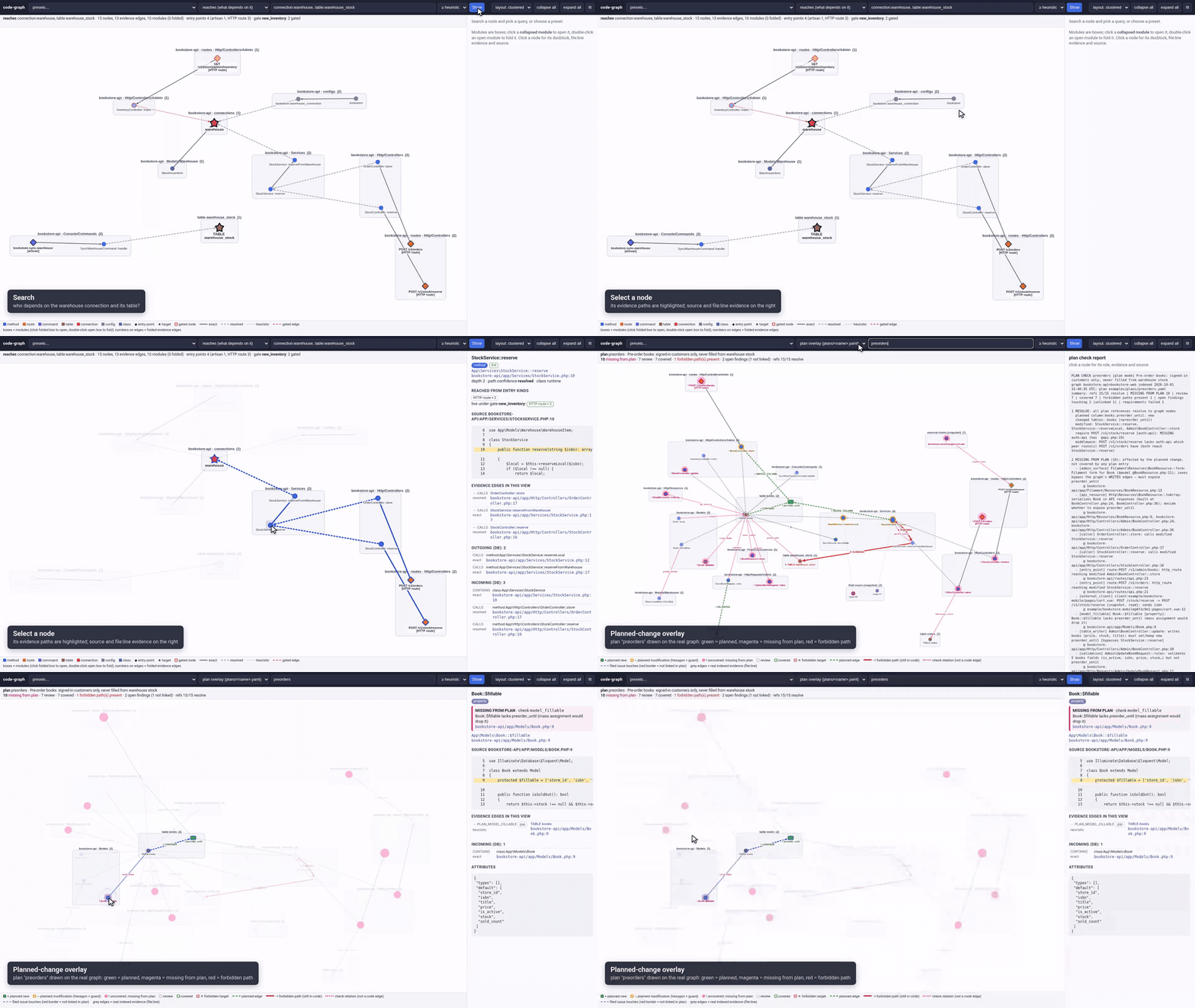
cg serve) and plan checks (cg plan check) for planned changes.
Docs
Install · Quick start · CLI · MCP · Configuration · Architecture · Limitations
Changelog · Contributing · Security · MIT License
More recordings: docs/media.
Installation
Source-derived launch command. Check the maintainer’s required arguments and credentials before running:
uvx cg-code-graphSet up in your AI client
Merge this template into ~/Library/Application Support/Claude/claude_desktop_config.json. Keep existing servers. Add any arguments, credentials, and permissions required by the maintainer; this template has not been install-tested.
{
  "mcpServers": {
    "io-github-cyberchronos00-cg-code-graph": {
      "command": "uvx",
      "args": [
        "cg-code-graph"
      ]
    }
  }
}
Restart Claude Desktop completely for changes to take effect. Confirm the server appears connected in the client’s tool list, then try a read-only example from its documentation.
Claude Desktop setup referencePackage
Compatible MCP Clients
code-graph works with any MCP-compatible client. Copy the config snippet from the Configuration section above and add it to the file shown for your client, then restart the application.
- Claude Desktop
~/Library/Application Support/Claude/claude_desktop_config.jsonRestart Claude Desktop completely for changes to take effect. - Cursor
~/.cursor/mcp.jsonRestart Cursor for changes to take effect. - VS Code
.vscode/mcp.jsonReload VS Code window for changes to take effect. - Windsurf
~/.codeium/windsurf/mcp_config.jsonRestart Windsurf for changes to take effect. - Claude Code
.mcp.jsonSave at the project root, then start Claude Code in that project and review the MCP server approval prompt. Keep real credentials out of shared files.