OneUptime
Manage incidents, alerts, monitors, status pages, on-call and telemetry in OneUptime.

Agentic observability — one open-source platform for uptime, incidents, on-call, status pages, logs, traces, metrics & APM.
When things go wrong, be the first to know — and the fastest to fix.
OneUptime replaces a whole shelf of SaaS tools with one platform you can self-host for free. It catches the outage, pages the right person, updates your status page, finds the root cause, and even opens the fix PR.
Website • Docs • Quick Start • Pricing • Contribute
Replace your whole observability stack
OneUptime brings monitoring, alerting, incident response, and observability into a single open-source app — so you stop paying for (and stitching together) a dozen separate tools.
| Instead of… | Use OneUptime for… |
|---|---|
| Pingdom / UptimeRobot | Uptime Monitoring — website, API, ping, port, SSL, DNS & synthetic checks from around the world |
| StatusPage.io | Status Pages — branded public & private status pages with subscribers |
| PagerDuty / Opsgenie | On-Call & Alerts — schedules, escalation policies, SMS / call / push / Slack |
| Incident.io | Incident Management — declare, triage, communicate, and post-mortem |
| Datadog / New Relic | APM & Metrics — traces, dashboards, and service performance |
| Loggly | Log Management — collect, search, and alert on logs |
| Sentry | Error Tracking — exceptions with full stack traces and context |
All of it is open source (Apache 2.0) and free to self-host in the Community Edition.
🌙 One incident, handled end to end
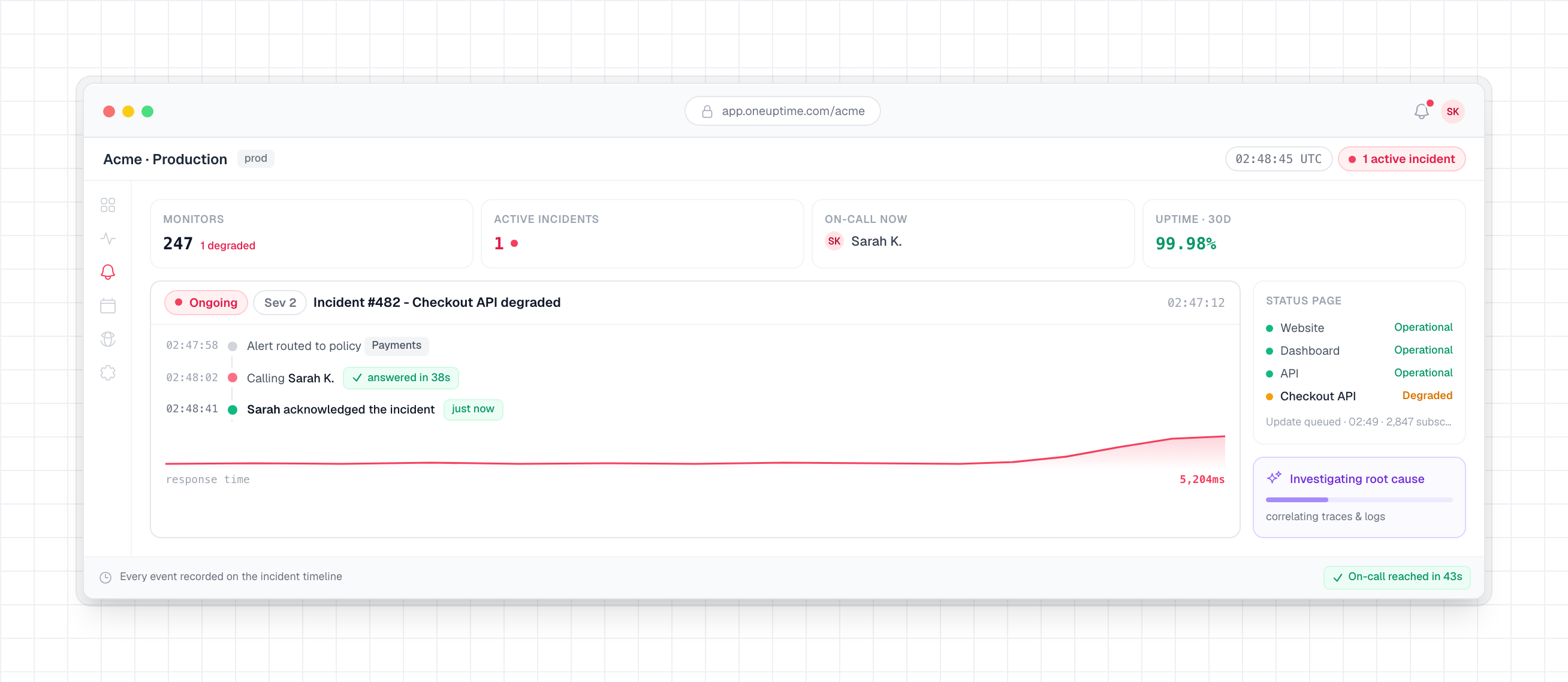
It's 2:47 AM. Checkout starts timing out. Here's what OneUptime does before most tools would even fire the first alert — and what the screenshots below actually show.
1 · Detect — know in seconds
Probes in multiple regions catch checkout latency blowing past your 5s threshold and open an incident automatically — before your customers hit refresh.

2 · Respond — the right person, paged
The on-call engineer for the Payments policy is called, texted, and push-notified, escalating to backup automatically until someone acknowledges.

3 · Communicate — customers in the loop
Your status page updates itself and every subscriber is notified by email and SMS — no one has to hand-write the update.

4 · Diagnose — root cause, found
Traces, logs, and metrics are correlated down to the exact span: a slow SELECT … FOR UPDATE on orders, stuck on a missing index.

5 · Auto-Fix — the fix, drafted for you
The AI agent opens a pull request with the fix, linked to the incident, verified against your repository's configured build and test commands before it opens — you review and merge. Like an SRE that never sleeps.

⚡ Quick Start
☁️ OneUptime Cloud — the easy way
Zero setup, always up to date, and it funds the open-source project.
→ Sign up free at oneuptime.com
🐳 Self-host with Docker Compose
Everything you need on a single server (Debian / Ubuntu / RHEL, Docker + Docker Compose). Great for homelabs and small teams — a Raspberry Pi even works.
# 1. Clone the release branch
git clone --depth 1 --single-branch --branch release https://github.com/OneUptime/oneuptime.git
cd oneuptime

# 2. Create your config, with a random value for every secret
cp config.example.env config.env
while grep -q "please-change-this-to-random-value" config.env; do
  sed -i "0,/please-change-this-to-random-value/{s/please-change-this-to-random-value/$(openssl rand -hex 32)/}" config.env
done

# 3. Start everything
npm start
OneUptime is now running at http://localhost — open it and create your first account.
📖 Full guide: Docker Compose install · Sizing & requirements
☸️ Kubernetes with Helm — for production
helm repo add oneuptime https://helm-chart.oneuptime.com
helm install oneuptime oneuptime/oneuptime
📖 Full install instructions & values on Artifact Hub →
Upgrading an existing install? See the upgrade guide.
✨ Everything in the box
| Feature | What it does | |
|---|---|---|
| 📊 | Uptime Monitoring | Website, API, IP, port, SSL, DNS, and synthetic monitors from multiple global regions. |
| 📋 | Status Pages | Beautiful branded status pages, incident history, scheduled maintenance, and subscriber notifications. |
| 🚨 | Incident Management | End-to-end incident workflow: declare, assign, communicate, resolve, and run post-mortems. |
| 📞 | On-Call & Alerts | On-call schedules and escalation policies with SMS, phone call, push, email, and Slack alerts. |
| 📝 | Log Management | Ingest, store, search, and alert on logs via OpenTelemetry. |
| 🔍 | APM & Traces | Distributed traces, spans, and performance dashboards to find slow paths and bottlenecks. |
| 📈 | Metrics & Dashboards | Custom dashboards over your telemetry — build the views your team needs. |
| 🐛 | Error Tracking | Capture exceptions with full stack traces, context, and release tracking. |
| ⚡ | Workflows | Automate and integrate with Slack, Jira, GitHub, Microsoft Teams, and 5,000+ apps. |
| 🤖 | AI Copilot | An always-on agent that finds anomalies across logs, traces & metrics, spots root causes, and opens PRs with fixes. |
⚡ Automate the busywork
Wire up escalations, ticketing, and notifications on a visual, no-code canvas — or drop in custom code. The incident above paged on-call, opened a Jira ticket, and posted to Slack without anyone lifting a finger.

🖥️ Infrastructure Monitoring
Drop in copy-paste, OpenTelemetry-based agents to watch everything your services run on — with ready-made alert templates included:
- Servers & VMs — CPU, memory, disk, network, processes, and logs from Linux, macOS & Windows. Docs →
- Kubernetes — one
helm installships node/pod/container/cluster metrics, events, logs, and eBPF traces & service maps. Docs → - Docker — a single agent auto-discovers every container and ships metrics & logs. Docs →
- Podman — same one-agent auto-discovery via Podman's Docker-compatible socket. Docs →
- Proxmox — nodes, VMs, containers, storage, HA state, backup coverage & replication health. Docs →
- VMware — vCenter, ESXi hosts, virtual machines, datastores, clusters, resource pools & vSAN. Docs →
- Ceph — cluster health, capacity forecasts, and OSD/pool/PG/monitor visibility. Docs →
- Storage Arrays — Pure Storage FlashArray and FlashBlade: capacity, latency, volumes, hosts, replication, hardware health, file systems and buckets. Docs →
- Databases — PostgreSQL, MySQL, Redis, MongoDB and more, auto-detected from application traces, Kubernetes and Docker, with engine metrics, query samples and logs from a config-only collector agent. Docs →
💼 Community vs. Enterprise
| Community | Enterprise | |
|---|---|---|
| Best for | Self-hosters & small teams | Regulated teams needing premium support |
| Cost | Free & open source | Contact sales |
| License | Apache 2.0 | Apache 2.0, plus the OneUptime Enterprise License for the ee/ directory |
| Features | Everything in the box above — monitoring, status pages, incidents, on-call, logs, traces, metrics, error tracking, workflows & AI — plus SAML & OIDC single sign-on | Everything in Community + SCIM provisioning, audit logs, team compliance & instance health dashboards, with priority support, custom features & data residency |
Enterprise features live in the ee/ directory and ship only in the Enterprise image. See Community vs. Enterprise Edition for the full comparison.
💡 Why OneUptime?
Our mission is simple: reduce downtime and help more products succeed. Instead of duct-taping seven vendors together, you get one platform that helps you understand why things break, respond to incidents fast, and cut operational toil — open source at its core (Apache 2.0), so you own your data and your stack.
🤝 Contributing
We welcome contributions of every size. Start here:
- 🐛 Open issues — pick one up, or file a new one
- ✅ Help write tests for the codebase
- 🧑💻 Local development guide to get set up
- 📖 Read the contributing guidelines
- 💬 Chat with us in the Developer Slack or Community Slack
❤️ Support the project
If OneUptime is useful to you:
- ⭐ Star this repo — it genuinely helps others find us
- 💵 Sponsor us — every dollar ships new features
- 🛍️ Grab some merch — all proceeds fund open-source development
📄 License
OneUptime is open source under the Apache License 2.0, except for the ee/ directory. That directory holds the Enterprise Edition and is licensed under the OneUptime Enterprise License. The Community Edition image contains no code from ee/. The root LICENSE file sets out this split.
Setup from the maintainer
This listing does not have a supported local package template. Use the maintainer’s documentation for its hosted endpoint, authentication, and client-specific setup. No install command has been inferred.